
Monday, April 29, 2019
Advice from the creator of Kentucky Derby Benedictine sandwiches - Jennie C. Benedict

Monday, April 22, 2019
Mary Randolph's refrigerator described by Harriott Pinckney Horry in 1815

Wednesday, April 17, 2019
Hot-cross Buns - 100,000 sold on one day in London

Monday, April 8, 2019
Piping icing through paper cornets or ox guts
 In an early (1842) detailed description to pipe icing onto cakes, paper was rolled into a cone, and the end was cut. In addition to "stout foolscap paper" the author also used small bags made of "gut of the ox" with tin tips. Urbain Dubois noted in his Artistic Cookery, 1870, that "icing-sugar, squeezed through a cornet" was an "innovation of rather recent date" and kept secret, which he learned in the 1840s in Rome.
Monday, March 25, 2019
Large scale pasta production in 1767

Monday, March 18, 2019
1911 Macaroni machine
 Huge macaroni machine in 1911 as compared with Jefferson's smaller version a hundred years before (below, more HERE ); from Artemas Ward's The Grocer's Encyclopedia. NY: 1911
Monday, March 11, 2019
Thomas Jefferson's Maccaroni machine

While in France, Jefferson ordered William Short (who was for a time his personal secretary) to buy a macaroni (Jefferson spelled it maccaroni) machine from Naples which eventually was shipped to America. Their correspondence and Jefferson's drawings are below. Click to enlarge
Friday, March 1, 2019
2 prong forks
 When the wider silver folks came out some continued to eat with two prong steel forks or knife. An American defended "that Americans have as good a right to their own fashions" and to eat off a knife in 1837. Even 15 years later a British visitor remarked on the habits of Baltimore women still using two prong forks.
Monday, February 18, 2019
Pepper pot street sellers in 1811, 1850 Philadelphia; 18th & 19th century recipes
 The peppery soup of tripe (stomach lining), meats and vegetables was very popular in Philadelphia. So popular, that later recipes were labeled "Philadelphia Pepper Pot" in cookbooks not published in Phila. British recipes for the dish "sort of clear-larder" of seasonal or leftover veggies; meats and even seafood (but no tripe), then highly seasoned with pepper. The Dutch (pepper trade) and Virginia Housewife connection?
Monday, February 11, 2019
"America Eats Project" of the 1930's Great Depression

HERE
Monday, February 4, 2019
Medieval Gyngerbrede

Monday, January 28, 2019
Francatelli's special dinner using Liebig's Extract of Meat 1869

Monday, January 21, 2019
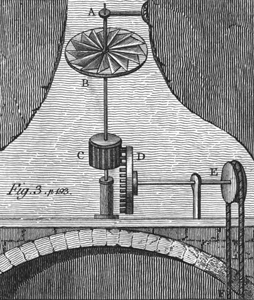
Smoke jacks
Monday, January 14, 2019
Federal-era kitchen apparatus in Gadsby's Indian Queen Hotel, Baltimore
 By 1815, the Indian Queen Hotel in Baltimore had state-of-the-art kitchen equipment: a "patent oven" (metal wall oven), "steam for boiling" (steam kitchens), "stoves set in brick" (stew stoves), smoke jacks to turn meat on spits and a coffee roaster.
Monday, January 7, 2019
Food history symposiums, conferences 2019
Along with the symposiums, there is an opportunity to apply for a paid summer fellowship at the cookbook collection of Michigan State University, and an exhibit at the Folger in DC.
Monday, December 31, 2018
Baked Alaska - Alaska Bake, "Alaska, Florida," Baked ice-cream, Hot Ice Cream, Roasted ice, and Glace meringue au four
 Alaska, a state for 60 years (Jan. 3) - only 60?! - was bought from Russia in 1867. Soyer's may have been the first recipe in English, Delmonico's in NYC the first to use "Alaska" as it's name, "Alaska Bake" appeared in a Phila. cookbook in 1886, "Baked Alaska" 1896 and Thomas Jefferson...
Monday, December 24, 2018
Farmer Giles's Establishment - Christmas Day 1800, 1829
 Printed in 1830, the image shows a well fed farmer, whose wife is slicing the plum pudding for dessert. The children sit at a stool, while one is standing on a bellows with the dog waiting for a slice. The hearth mantle is decorated with greens.
 Monday, December 17, 2018
18th & 19th century Christmas decorating with holly and mistletoe
 Holly and other greens not only festooned homes, taverns, churches and "Christmas sports," they also decorated plum puddings, boar's heads and other food items. Hundreds of men gathered the greens - "a-Christmasing" - often trespassing.
Monday, December 10, 2018
Selling Oysters
 Oysters were sold on the streets 'on the half shell' and served with vinegar, salt, pepper, and/or cracknels. The following images are from Cries of London, New York and Philadelphia from the late 1500s and 1688 through the 18th and 19th centuries. Click to enlarge.
 Monday, December 3, 2018

Subscribe to:
Posts (Atom)

 Posts
Posts

