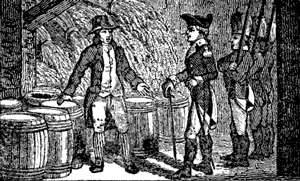
Flour barrels everywhere - “I shall have no visitors.”
Jan 6 - Five years. Never forget the horrific attack on the police and the Capitol building in 2021. I never will. Staff included the teenage pages - one of my sons was a page during the summer some years ago. I spent several years researching the Civil War bake ovens in the Capitol and wrote a booklet in 2014.
Showing posts with label Flour. Show all posts
Tuesday, January 6, 2026
Sunday, November 6, 2022
Revolutionary War comes to the Tatnall and Lea mills in Delaware
During the Revolutionary War the Tatnall and Lea flour mills of Brandywine, by Wilmington, Delaware furnished flour to the American army. Washington and Lafayette visited Joseph Tatnall. Before the battle of the Brandywine, Washington ordered the top grinding stones of the mills to be removed and hidden from the British troops.
Labels:
Flour,
Lea (Elizabeth Ellicott),
Military,
Mills,
Revolutionary War
Monday, August 12, 2019
Garlick flour
Wild garlic, grown among the wheat plants, caused problems in the mills by gumming up the mill stones and later, the rollers. Although it was almost impossible to "destroy the garlick" in the fields, farmers shared their attempts such as using plaster of Paris. One early author claimed that the Hessians during the Rev War introduced it. As for grinding the grain with the garlic seeds - Oliver Evans wrote his method to "dress" the mill stones and several inventions were patented.
Monday, April 16, 2018
Flour as a war target
Monday, June 13, 2016
Sharpening Millstones
At one time thousands of grist mills operated with sets of two grinding stones. They were obtained from England, then France, but could also be quarried in some locales (see below). The mill stones had to be sharpened periodically.
Monday, October 6, 2014
Barbegal: a SUPER Roman flour mill complex
16 overshot wheels - using water from an aqueduct - ground an estimated four and a half tons of flour per day! If
that was not enough, the Romans cut through solid rock on top to connect the aqueduct
they built to the mill troughs. AND they built the stone complex on a steep hill in Gaul (France). All this during the 1st century.Monday, January 28, 2013
Flour bin at Zoar
Thursday, December 13, 2012
Panetieres
Subscribe to:
Posts (Atom)