 16 overshot wheels - using water from an aqueduct - ground an estimated four and a half tons of flour per day! If
that was not enough, the Romans cut through solid rock on top to connect the aqueduct
they built to the mill troughs. AND they built the stone complex on a steep hill in Gaul (France). All this during the 1st century.
Monday, October 6, 2014
Barbegal: a SUPER Roman flour mill complex
16 overshot wheels - using water from an aqueduct - ground an estimated four and a half tons of flour per day! If
that was not enough, the Romans cut through solid rock on top to connect the aqueduct
they built to the mill troughs. AND they built the stone complex on a steep hill in Gaul (France). All this during the 1st century.
Monday, September 29, 2014
Smelly beef steak pie by the Thatched House Tavern cook and his 1824 cookbook
 Michael Willis, as the cook for many years at the Thatched House Tavern, prepared meals for members of the prestigious clubs which met there. He wrote Cookery Made Easy in 1824 and another in 1831.
Monday, September 22, 2014
Sargent's The Dinner Party - Mystery object
 Does anyone have a guess what the small object on the floor near the sideboard is and why is it at that location? (closeup below) I would think a stool, heater (food, dish), brazier bottom or whatever would trip up the servers. The Dinner Party by Henry Sargent (1770-1845) was painted c1821 in Boston.
Monday, September 15, 2014
Woman Guard your Kitchen!
 The dog - wish I could say 'hot dog' (dachshund) - is stealing Mrs. Weiser's sausages in this watercolor by Lewis Miller.
Thursday, September 4, 2014
Jefferson's handwritten list of the Vegetable Market in Washington City
 Artichokes, Broccoli, Eggplants, Sprouts and Watermelon were just some of the 37 vegetables and fruits sold from 1801-1809 and written down by Thomas Jefferson. An
avid gardener and collector, Thomas Jefferson kept records of the wide variety of plants in his gardens,
but as President he also kept track of the vegetable market in Washington, D.C.,
charting the first and last days the vegetables were available.
Tuesday, September 2, 2014
Dutch Oven - Iron or Tin or ... Brick?
 What's in a name...? Several types of ovens have been called Dutch Ovens. They were generally cast iron bake ovens, or metal (tin or copper) reflector ovens. Some inventories specified – “2
iron dutch ovens with only one lid” or “tin dutch ovens” while others listed only
“oven” or “dutch oven.” And then the brick...
Monday, August 25, 2014
Spiced Peaches and Pickled Peaches
 TEN
peach recipes are in Elizabeth Ellicott Lea’s Domestic Cookery (Baltimore,
1846) including Spiced Peaches and To Pickle Peaches. The Spiced Peaches (left) are delightful, but they cook down, so do halves or quarters.
Monday, August 18, 2014
They came, they ate, they burned the house down - the British burning the White House in 1814
 On August 24, 1814, food was prepared for a 3:00 dinner for forty. There were cut glass decanters of ale, cider and wine placed in coolers, plate warmers by the fire and a variety of meats on the spits. The British troops sat down to a fine repast... then immediately set fire to the President's House. A nice thank you for the meal.
Monday, August 11, 2014
Civil War salt works - 500 bushels a day - destroyed
 Salt was important to preserve meat (like salt pork) in order to feed the soldiers. Thus, the Union navy conducted raids on Confederate salt-works, as illustrated and described in Harper's Weekly, Nov. 15, 1862.
Monday, August 4, 2014
Food History Symposiums, Exhibits 2014 part 3
8 activities in Washington, D.C., Williamsburg VA, MS, NJ, Russia and Italy...
Monday, July 28, 2014
Thomas Jefferson and Ice Cream
 Balls
of ice cream encased in warm pie crust made by Jefferson's French chef were novel enough to stir
comment by TWO Congressmen attending a Presidential dinner. Among Jefferson's few handwritten recipes is one for
vanilla ice cream. A 1786 French book of ice creams, an early British cookbook with recipe - which he owned - ice cream freezer in his inventory, and more...
Monday, July 21, 2014
Madeira - a Pot and a Quern
 Madeira, the island off the coast of Portugal, not the fortified wine made there, was the subject of the 1821 book A History of Madeira. Porridge is in the iron pot and grinding "Indian corn" in a quern is depicted below.
Monday, July 14, 2014
Ice Cream Man in 1845 New York City and 1815 London

Monday, July 7, 2014
Roll out the barrel ...on a sled
 Foodstuffs and other items were stored in sacks, boxes, crates, jars and barrels of all sizes. Smaller barrels could easily be put in wagons, but how did they transport the larger barrels? The Madeira barrel on a sled (1821) is described below.
Monday, June 30, 2014
Saddle, griddle and oatmeal for oatcakes
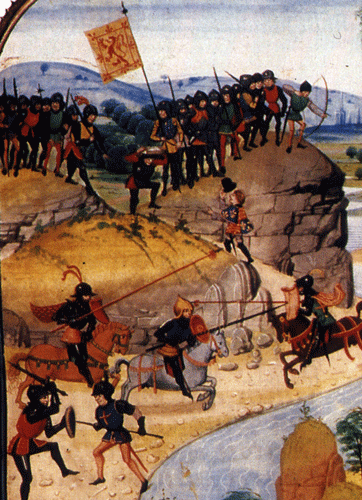 Traveling with "a broad plate of metal" (a 'girdle' or griddle) "under the Haps [cover, wrap] of his saddle," the fourteenth century Scottish soldier could make thin oat cakes from water and oatmeal over a fire. This would warm and strengthen their stomachs after eating too-freshly butchered cattle, which was scavenged.
Monday, June 23, 2014
The Drunken Botanist
 This
entertaining and well researched book details how all alcoholic beverages are
composed of plants. Actually, it is the focus on each plant and how it is made into different drinks, instead of the usual writings on the composition of beer, wine, etc., which makes this an interesting read. Beer is generally barley,
wheat, and flavored with hops. But going
from plant to drink - barley is also for whiskey; wheat is in vodka, whiskey
and Maker’s Mark bourbon.
Monday, June 16, 2014
Midsummer Eve dining with newcomers
Monday, June 9, 2014
"Fifty Years in a Maryland Kitchen"...and Belvidere

Tuesday, June 3, 2014
Cherries on a stick

Cherries were tied with white thread to sticks in addition to being
sold by weight. Some sticks held up to eleven
bunches (1825) and 350
years earlier “Cheryes in the ryse…a twig.” Numerous sketches of cherry 'kabobs' and info below...
Tuesday, May 27, 2014
A day at White Sulphur Springs... in 1869
Subscribe to:
Posts (Atom)

 Posts

