
Monday, July 14, 2014
Ice Cream Man in 1845 New York City and 1815 London

Monday, July 7, 2014
Roll out the barrel ...on a sled
 Foodstuffs and other items were stored in sacks, boxes, crates, jars and barrels of all sizes. Smaller barrels could easily be put in wagons, but how did they transport the larger barrels? The Madeira barrel on a sled (1821) is described below.
Monday, June 30, 2014
Saddle, griddle and oatmeal for oatcakes
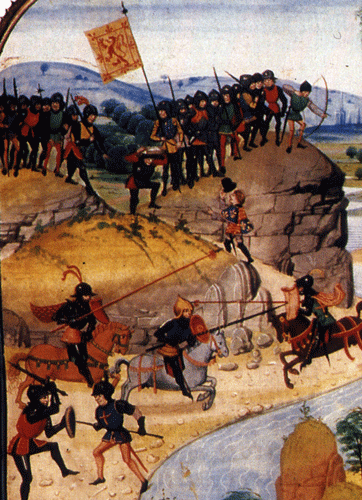 Traveling with "a broad plate of metal" (a 'girdle' or griddle) "under the Haps [cover, wrap] of his saddle," the fourteenth century Scottish soldier could make thin oat cakes from water and oatmeal over a fire. This would warm and strengthen their stomachs after eating too-freshly butchered cattle, which was scavenged.
 Monday, June 23, 2014
The Drunken Botanist
 This
entertaining and well researched book details how all alcoholic beverages are
composed of plants. Actually, it is the focus on each plant and how it is made into different drinks, instead of the usual writings on the composition of beer, wine, etc., which makes this an interesting read. Beer is generally barley,
wheat, and flavored with hops. But going
from plant to drink - barley is also for whiskey; wheat is in vodka, whiskey
and Maker’s Mark bourbon.
This
entertaining and well researched book details how all alcoholic beverages are
composed of plants. Actually, it is the focus on each plant and how it is made into different drinks, instead of the usual writings on the composition of beer, wine, etc., which makes this an interesting read. Beer is generally barley,
wheat, and flavored with hops. But going
from plant to drink - barley is also for whiskey; wheat is in vodka, whiskey
and Maker’s Mark bourbon.Monday, June 16, 2014
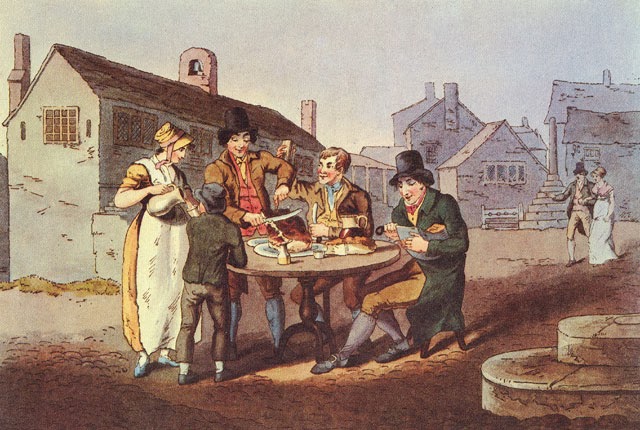
Midsummer Eve dining with newcomers
Monday, June 9, 2014
"Fifty Years in a Maryland Kitchen"...and Belvidere

Tuesday, June 3, 2014
Cherries on a stick

Cherries were tied with white thread to sticks in addition to being
sold by weight. Some sticks held up to eleven
bunches (1825) and 350
years earlier “Cheryes in the ryse…a twig.” Numerous sketches of cherry 'kabobs' and info below...
Tuesday, May 27, 2014
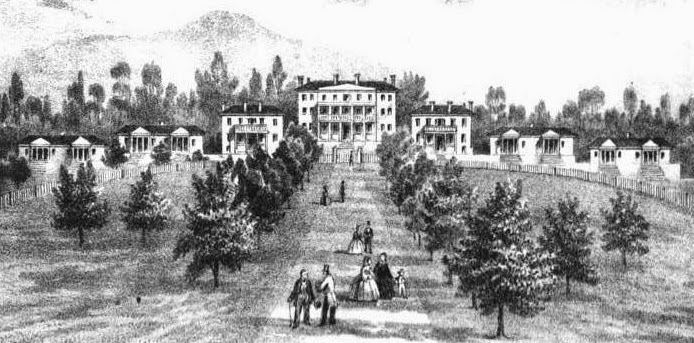
A day at White Sulphur Springs... in 1869
Monday, May 19, 2014
Petticoat Tails

Tuesday, May 13, 2014
Spring Cakes

Two Spring Cakes, one with candied violets, and angelica stems from 1920, and a Regency recipe, Gateau de Mai (Cake of May) which is not sweet... using udder, suet, herbs, spices and served with stewed greens or sharp sauce.
Monday, May 5, 2014
Stuffing stomachs for Haggis and Hog Maw

Monday, April 28, 2014
Food History Symposiums, Talks, Workshops 2014. part 2
11 Activities in Virginia, Maryland, Ireland, Amsterdam, UK, Italy, Mass., Miss., and Ill.
Monday, April 21, 2014
A wig for the cook - 1776

Monday, April 14, 2014
Eggs and onion skins
 The marvelous mahogany hues of hard-boiled eggs boiled in onion skins make a wonderful backdrop to etch with a needle or knife, as seen in the eggs done by Tom Martin at Landis Valley Museum in Lancaster, Pa. 1826 and 1876 directions...
Monday, April 7, 2014
Saratoga Chips - Potato Chips

Tuesday, April 1, 2014
Egg shell perfumed bombs - 1685
 Egg shells filled with scented rose-water were to be thrown by the ladies during banquets... after the cannons were fired on board pastry boats... to cover the smoke smell. Then live birds and frogs came out of the pies. Robert May described how to make these and other incredible dishes in his The Accomplisht Cook, 1685. ...
Monday, March 24, 2014
Food prices were lower in Federal America than Regency England
 In
1818 Cobbett listed the many “groceries” the Americans paid half or even a
third the price that the British paid.
Furthermore, everyone was able to partake of chocolate “which is a treat
to the rich in England.” The British
people paid to keep the Indies, and yet,
“What a hellish oppression must that people [Americans] live under!”
In
1818 Cobbett listed the many “groceries” the Americans paid half or even a
third the price that the British paid.
Furthermore, everyone was able to partake of chocolate “which is a treat
to the rich in England.” The British
people paid to keep the Indies, and yet,
“What a hellish oppression must that people [Americans] live under!”
Tuesday, March 18, 2014
Mangles
 For
hundreds of years depictions have shown extensive creases on the tablecloths.
This was achieved by ironing, placing in a napkin press and later, in the mangle.
Several references show that the mangle was available in the early federal
period, but more widespread in the 19th to the early 20th centuries.
For
hundreds of years depictions have shown extensive creases on the tablecloths.
This was achieved by ironing, placing in a napkin press and later, in the mangle.
Several references show that the mangle was available in the early federal
period, but more widespread in the 19th to the early 20th centuries.Monday, March 10, 2014
Oven Radiator
 Radiators could do more than heat a room. The steam pipes could warm plates, keep food hot for the table, or raise bread dough as was done in 'warming ovens' and 'hot closets'....
Monday, March 3, 2014

Subscribe to:
Posts (Atom)

 Posts
Posts

