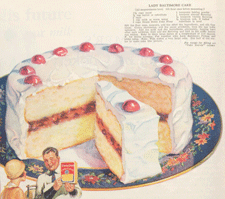
 Described in the novel Lady Baltimore (1906) as "all soft, and
it's in layers, and it has nuts,"
the Lady Baltimore Cake has more to do with Philadelphia than Baltimore
or even Charleston (before the book was published). ...
Described in the novel Lady Baltimore (1906) as "all soft, and
it's in layers, and it has nuts,"
the Lady Baltimore Cake has more to do with Philadelphia than Baltimore
or even Charleston (before the book was published). ...Monday, September 9, 2013
Lady Baltimore Cake
Described in the novel Lady Baltimore (1906) as "all soft, and
it's in layers, and it has nuts,"
the Lady Baltimore Cake has more to do with Philadelphia than Baltimore
or even Charleston (before the book was published). ...
Monday, September 2, 2013
Young cooks in a French kitchen, 1890s
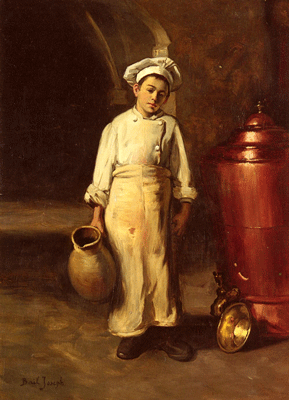 Joseph Bail (French, 1862-1921) painted many views of kitchen helpers and
young cooks.
Joseph Bail (French, 1862-1921) painted many views of kitchen helpers and
young cooks.
On this Labor Day, I’ve included some of his paintings depicting children working in a kitchen c.1893 ... a few of the scenes are playful, others poignant.
Monday, August 26, 2013
Pickled and Stuffed Olives

Monday, August 19, 2013
Cooking and Dining onboard 19th century railroad cars
 Pullman "Hotel Cars" in 1882 contained many ingenious devices such as a compact kitchen range/oven and temporary dining tables from "well-polished mahogany planks."
Monday, August 12, 2013
Chiffon Cake - a new sponge cake in 1948
 Savoy Cake, Elkridge Huckleberry Pudding, and Victoria Sponge Cake were just some types of sponge cake.... and then, in 1948 ... Betty Crocker's Chiffon Cake.
 Generally, sponge cakes were made with flour, sugar, and eggs - the whites beaten hard for leavening. No butter, water or baking powder/soda. The new Chiffon Cake had oil, water and baking powder.
Monday, August 5, 2013
Ice Tea, Sweet Tea history

Early references to Ice Tea dealt with its immense popularity in Russia in the 1840s; and by 1860 it appeared in American books. The Russian influence was noted in recipes labeled Russian Tea or Tea a la Russe.
A northern cookbook contained the first recipe in a cookbook to brew sugar with the hot water – sweet tea – before the usually cited Old Virginia cookbook of 1877. Another early sweet tea appeared in a medical recipe. ...
Monday, July 29, 2013
Butter shapes - 2
 Continuing with Dutch, Flemish and French butter in paintings from the 17th, 18th and 19th centuries.
 The butter in a mound shape is from Pieter de Hooch's A Woman Preparing Bread, (Dutch c1660) in the Getty Museum.
Monday, July 22, 2013
Fried RED Tomatoes
 For those of us who love green fried tomatoes, here is a delicious 1839 recipe for fried red ones with bread crumbs and fried minced onions...
Tuesday, July 16, 2013
Yorkshire Range video

“The Old Black Lead Range” a seven minute video of Peter Brears cooking on the range is on Youtube HERE . The Yorkshire Range, popular in English kitchens from the 1850s, was an ‘open range.'
Monday, July 1, 2013
Cook Stove Videos
 The two short videos below, show cooking on early cast iron cook stoves, bringing to life these 19th century images. The first stove has an upper or step-up oven, while the second is a box stove with oven.
 Tuesday, June 25, 2013
Butter Shapes

Monday, June 17, 2013
Jefferson's Savoy Cakes
 President Thomas Jefferson actually wrote this recipe. And others, some written in French. This recipe To make biscuit de Savoy includes an interesting step - "take care not to shut the oven till the biscuit begins to swell up, then close the oven."
Monday, June 10, 2013
Garlic Butter
 Not for Italian bread...but when cows ate wild garlic in the spring, the flavor remained in the
milk, and the cream was churned into garlic flavored butter.
Not for Italian bread...but when cows ate wild garlic in the spring, the flavor remained in the
milk, and the cream was churned into garlic flavored butter.Monday, June 3, 2013
Strawberry Cakes - Eliza Leslie

Monday, May 27, 2013
HUGE fish smoker - 1779
 This incredible kiln to smoke red herring is pictured in a French book published in 1779. The fish were strung through sticks which were then passed up to be hung. After being dried in the smoke, the fish were taken down, pulled off the sticks and put in barrels. While there are a couple women helping in the first image, all the workers in Figure 2 - even those climbing in their long dresses - are women. Click on the images for larger views.
Monday, May 20, 2013
Barding and Larding
 How to bard, how to lard? Images of larded and barded meat with instructions appeared in Miss Corson's Practical American Cookery in 1886...
Monday, May 13, 2013
Incorporators for Salad Dressing
 Odd bottle #2. Once the dressing for the salad was made, it was put in a bottle or
poured down the side of the 'salad dish', to be mixed only when ready to eat,
according to William Kitchiner. He specified
“an Ingredient Bottle, - These are sold at the Glass Shops, under the name of
Incorporators,— we recommend the sauce to be mixed in these, and the Company
can then take it, or leave it, as they like.”
[The Cook's Oracle by William Kitchiner.
London: 1822]
Odd bottle #2. Once the dressing for the salad was made, it was put in a bottle or
poured down the side of the 'salad dish', to be mixed only when ready to eat,
according to William Kitchiner. He specified
“an Ingredient Bottle, - These are sold at the Glass Shops, under the name of
Incorporators,— we recommend the sauce to be mixed in these, and the Company
can then take it, or leave it, as they like.”
[The Cook's Oracle by William Kitchiner.
London: 1822]Monday, May 6, 2013
Codd Bottles
 Marbles inside soda bottles?? This ingeneous replacement for the cork used the soda water's own pressure to keep the marble secured against a rubber ring just under the lip. To release the seal, a special opener (see below) or finger pushed the marble ball away from the ring.
Tuesday, April 30, 2013
Here's Milk, ho!
 Selling milk from 12 gallon cans, from the 1808 book The Cries of New-York with a description. Also pictures from 1795 and 1805 Great Britain.
Monday, April 22, 2013
Spring Puddings and Rhubarb
 Rhubarb, with its strikingly red stalks and large green leaves, became popular in Victorian England and by 1822 was the main ingredient in Spring Puddings. The "pie-plant" was forced by the warmth of the waste water from the boilers of the factories... in Yorkshire...
Subscribe to:
Posts (Atom)

 Posts
Posts

